
A dual dash cam for the front and rear of your vehicle provides different levels of detail and file management. While many models offer high resolution, the real differences lie in sensor technology for low-light performance, the speed of your wireless transfers, and the type of parking protection provided.
Best overall: VIOFO A229 Plus, which uses dual Sony STARVIS 2 sensors to balance high-resolution recording with improved night vision, making it a reliable choice for most drivers.
Best for low light: ROVE R2-4K Dual, which pairs its advanced STARVIS 2 sensor with a wide F1.5 aperture to pull in extra light during nighttime or dusk driving.
Best for ease of use: REDTIGER F7NP, which simplifies the process by including a memory card in the box and using a user-friendly app for quick video management.
The rest of this guide is for drivers who want to compare the specific hardware capabilities of these top-rated dual-channel systems.
How We Picked
We compared 16 different dash cam listings to identify models that offer reliable dual-channel performance. To earn a place in this article, a product had to clearly state its sensor type, resolution, and parking mode options. We excluded any models that lacked clear specifications on their connectivity or mounting hardware.
All 10 products side by side — scroll sideways to see every column.
| Top Pick | Best for City Drivers | Also Great | Best for Full Coverage | Best for Fast Transfers | Best for Professionals | Best for Families | Best for Hidden Look | Best for Large Screens | ||
| Preview |  |  |  |  |  |  |  | 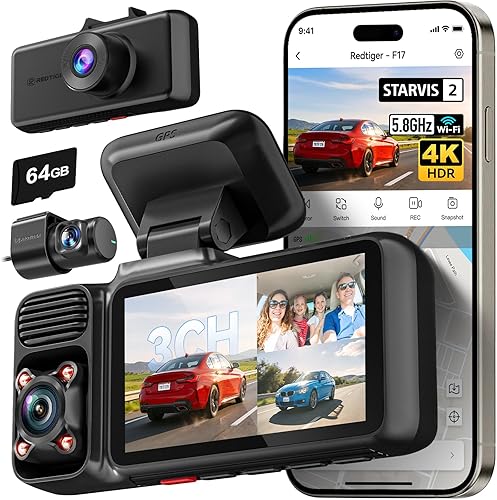 |  |  |
|---|---|---|---|---|---|---|---|---|---|---|
| Product | VIOFO A229 Plus | ROVE R2-4K Dual | REDTIGER F7NP | 360 View 4 Channel | BOTSLAB G300H Plus | 4K+4K WiFi6 Dash Cam | ROVE R2-4K Pro | REDTIGER F17 3CH | 4K+2K Starvis 2 | 4K+2.5K Dual Dashcam |
| Brand | VIOFO | ROVE | REDTIGER | ZMOPO | BOTSLAB | TERUNSOUl | ROVE | REDTIGER | COXPAL | Affver |
| Best for | Best Overall | Best for City Drivers | Also Great | Best for Full Coverage | — | Best for Fast Transfers | Best for Professionals | Best for Families | Best for Hidden Look | Best for Large Screens |
| The listing says | Dual Sony STARVIS 2 IMX675 sensors Dual-channel HDR front and rear recording | Upscaled 4K front and 1080P rear Sony STARVIS 2 IMX675 sensor | 4K front and 1080P rear recording STARVIS 2 sensor with WDR technology | Four 1080P cameras for full coverage Time-lapse recording and parking mode | 18-month product coverage STARVIS 2 sensor with HDR | 4K front and 4K rear recording AProX HD night vision with F1.5 aperture | 4K front and 2K rear recording Sony IMX678 and IMX675 sensors | 4K front, 1080P cabin, 1080P rear STARVIS 2 IMX675 sensor with HDR | 4K front and 2K rear recording STARVIS 2 IMX678 sensor with HDR | 4K front and 2.5K rear recording 160° front and 155° rear view |
| More information | Check Latest Price on Amazon | Check Latest Price on Amazon | Check Latest Price on Amazon | Check Latest Price on Amazon | Check Latest Price on Amazon | Check Latest Price on Amazon | Check Latest Price on Amazon | Check Latest Price on Amazon | Check Latest Price on Amazon | Check Latest Price on Amazon |
1. VIOFO A229 Plus Dash Cam Front and Rear
Best for: Drivers needing balanced day and night performance.
The VIOFO A229 Plus stands out by using Sony STARVIS 2 sensors for both the front and rear cameras. This technology provides 2.5 times the dynamic range and light sensitivity of older sensors, which significantly reduces motion blur and noise. It’s the ideal choice when you need to capture license plate details in challenging light.
If you prioritize smooth motion, use the 1440P 60fps mode. However, if you need to resolve high-contrast scenes, switch to the Dual-Channel HDR mode. Be aware that enabling HDR limits the front camera to 30fps. Always check your settings, as the system won’t record at 60fps while HDR is active.
This camera is an excellent fit for those who want a set-and-forget system with 12 voice commands to lock clips while driving. It isn’t the right choice for someone who demands native 4K resolution, as this unit caps at 2K for both channels. To utilize the 24/7 parking modes—Auto Event Detection, Time Lapse, or Low Bitrate—you must purchase the HK4 hardwire cable separately.
Pros
- Dual Sony STARVIS 2 sensors
- Fast 5GHz Wi-Fi transfers
- Intuitive voice command system
Cons
- Hardwire kit sold separately
- HDR limits frame rate
2. ROVE R2-4K Dual Dash Cam Front and Rear
Best for: Nighttime commuters and city drivers.
The ROVE R2-4K Dual uses an upscaled 4K front resolution to provide sharp detail for road signs and license plates. Its F1.5 aperture is designed to let in more light, which is a significant advantage when driving in dark tunnels or at night. The inclusion of a 128GB memory card means you’re ready to record as soon as you finish the installation.
If you drive frequently at night or through tunnels, the Sony STARVIS 2 IMX675 sensor provides the clarity you need to capture license plates and surrounding vehicles. Use the 5.8GHz WiFi to download clips to your phone at 20 MB/sec if you need to share evidence quickly.
This device is ideal for users who prioritize night visibility above all else. It isn’t suitable for people who require a discrete, screenless design, as this model features a 3-inch IPS display. If you want 24-hour parking protection, you must purchase a hardwire kit separately. Without this kit, you lose access to the motion and collision detection features while parked.
Pros
- Large F1.5 aperture lens
- Includes 128GB memory card
- Built-in thermal protection
Cons
- Upscaled 4K resolution
- Hardwire kit not included
3. REDTIGER F7NP 4K Dash Cam Front Rear
Best for: First-time dash cam buyers.
The REDTIGER F7NP is built around a STARVIS 2 sensor and offers a straightforward 4K front recording experience. It includes a memory card and uses a supercapacitor, which is generally more resistant to heat than a traditional lithium battery.
If you live in an area with extreme heat, the supercapacitor is your primary defense against premature hardware failure. However, don’t assume this makes the unit invincible. If the camera overheats during intense exposure, disconnect the power immediately and allow it to cool down to protect the internal components.
This model is a great pick for those who want a reliable, no-fuss setup right out of the box. It isn’t recommended for users who want to record the cabin interior, as this is a traditional front-and-rear two-channel system. To ensure the 5.8GHz WiFi functions at its peak speed of 20MB/s, always use the original charging cables provided. Using low-quality third-party accessories often causes unstable power delivery, which can corrupt your loop recording files or lead to unexpected reboots.
Pros
- Heat-resistant supercapacitor design
- Memory card included
- 18-month warranty coverage
Cons
- Rear camera is 1080P
- Hardwire kit required for parking
4. 360 View 4 Channel
Best for: Drivers wanting total vehicle coverage.
The 360 View 4 Channel provides a unique perspective by recording the front, rear, and sides of your vehicle simultaneously. This setup is useful if you’re concerned about side-impacts or blind-spot visibility. Because it processes four streams of video, it’s a comprehensive security tool for fleet or family vehicles that need to monitor all angles.
If you prioritize parking security, you must purchase the optional ACC hardwire kit. Without this specific addition, the 24-hour parking mode won’t function, leaving your vehicle vulnerable while unattended.
This system is best for those who need maximum coverage. It isn’t for the minimalist driver, as managing four separate camera feeds requires more installation time and cable routing. If you need to track your route, speed, or location, remember that the GPS logger is sold separately. Relying on the base unit alone won’t provide these travel details.
Pros
- Four-camera full coverage
- 5GHz Wi-Fi integration
- 24-month support period
Cons
- Hardwire kit sold separately
- GPS logger sold separately
5. BOTSLAB G300H Plus 4K Dual Dash Cam Front and Rear
Best for: Users who value modern connectivity and fast data access.
The BOTSLAB G300H Plus features a 4K front camera paired with an F1.5 aperture lens to enhance low-light performance. Its use of 5.8GHz Wi-Fi allows for file transfers ten times faster than standard 2.4GHz connections, a major convenience when pulling evidence quickly. The voice control feature lets you manage basic functions like starting a video or taking a photo without taking your hands off the steering wheel.
This is a great option for tech-savvy drivers who want quick access to their footage. However, you can’t use this dash cam’s Wi-Fi and Apple CarPlay at the same time. Because iPhones only support one active Wi-Fi connection, connecting to one will automatically disconnect the other. If you rely on wireless CarPlay for navigation, expect to disconnect it whenever you need to download footage via the app.
The unit includes a 64GB card and supports up to 256GB. To enable the round-the-clock parking monitor for continuous recording, you must purchase a separate hardware kit.
Pros
- Fast 5.8GHz Wi-Fi
- Sensitive voice control
- 18-month warranty
Cons
- Wi-Fi conflicts with CarPlay
- Hardwire kit required for parking mode
6. 4K+4K WiFi6 Dash Cam
Best for: Users needing the fastest file transfers.
The 4K+4K WiFi6 Dash Cam uses the latest Wi-Fi 6 standard to move large 4K files to your smartphone at speeds up to 20MB/s. With both front and rear cameras recording in 4K, this unit provides high-definition evidence from both directions. The front camera captures a 170° angle, while the F1.5 and F1.8 apertures ensure clarity in low light.
The inclusion of a 128GB card means you don’t need to shop for extra storage immediately. If you need more space, the device supports cards up to 512GB. Loop recording manages your storage automatically, but ensure you format your card regularly to maintain system health.
This camera is perfect for those who frequently download footage to their phones. It isn’t ideal for users with older smartphones that may not fully support the latest Wi-Fi 6 wireless protocols. If you intend to use all-day parking monitoring, you must purchase a hardwire kit separately. Without this kit, the camera won’t record while the vehicle is powered down.
Pros
- Fast WiFi 6 connectivity
- Dual 4K recording channels
- Includes 128GB memory card
Cons
- Hardwire kit sold separately
- Larger file sizes require storage
7. ROVE R2-4K Dual PRO Dash Cam Front and Rear
Best for: Professional drivers and ride-share operators.
The ROVE R2-4K Pro uses high-end Sony STARVIS 2 sensors (IMX678 front and IMX675 rear) to ensure clarity in all lighting conditions. The inclusion of a CPL filter is a standout feature, as it helps reduce windshield glare and reflections that can otherwise obscure license plates. Its Quad-Mode GPS provides highly accurate location and speed tracking for detailed incident logs.
If you prioritize evidence, use the 1FPS time-lapse setting for long-term parking coverage. If you need immediate proof of an incident, rely on the motion or collision detection modes, which trigger a locked one-minute recording. Always remember that the continuous parking monitor requires a separate hardwire kit; without it, the camera only records while the ignition is on.
This is a top-tier choice for those who need professional-grade evidence, such as a CPL filter or advanced Quad-Mode GPS.
Pros
- Dual STARVIS 2 sensors
- Includes CPL filter
- Fast 30MB/s transfer speed
Cons
- Hardwire kit sold separately
- Higher complexity for setup
8. REDTIGER F17 4K 3CH Dash Cam
Best for: Families and ride-share drivers.
The REDTIGER F17 3CH captures the road ahead, the road behind, and the interior of the cabin. This triple-channel approach is essential for ride-share drivers who need to document the interior of their vehicle for safety. It uses a supercapacitor, which is a reliable choice for long-term durability in fluctuating temperatures.
If you prioritize maximum resolution, turn off the cabin camera. This enables 4K front and 1080P rear recording, which keeps your footage sharper than the 2.5K dual-channel mode. Use the 5GHz Wi-Fi setting to transfer these large files to your phone four times faster than standard 2.4GHz connections.
This camera is best for those who need internal monitoring. It isn’t for drivers who only care about the road ahead, as the interior camera adds unnecessary complexity for that specific use case. Always purchase the extra hardwire kit if you intend to use the parking monitor, as the camera requires it to trigger collision detection or time-lapse recording while your vehicle is stationary.
Pros
- Three-channel coverage
- Heat-resistant supercapacitor
- 5GHz Wi-Fi speed
Cons
- Hardwire kit sold separately
9. 4K+2K Dual Dash Cam Front and Rear
Best for: Drivers who prefer a hidden look.
The 4K+2K Starvis 2 features a screenless, compact design that hides easily behind your rearview mirror. By removing the screen, the unit runs cooler and maintains a lower profile, which is perfect for maintaining the interior aesthetics of your car. It supports up to 512GB of storage, allowing for many hours of continuous loop recording.
If you prioritize evidence, use a high-speed UHS-1 U3 microSD card. Using a slower card will cause recording failures or corrupted files when capturing the high-bitrate 4K front and 2K rear video.
This is the best choice for a clean, minimalist installation. It isn’t for users who want to review their footage directly on the dash cam screen, as there’s no built-in display. If you need to verify footage on the road, use the 5GHz WiFi connection to download clips directly to your phone via the app.
Pros
- Discreet, screenless design
- High-capacity storage support
- Reliable 3M adhesive mount
Cons
- No built-in screen
- Hardwire kit required for 24H parking mode
10. 4K+2.5K Dash Cam Front and Rear
Best for: Drivers who want a large display.
The 4K+2.5K Dual Dashcam features a 3.59-inch IPS screen, making it one of the easiest models to navigate when adjusting settings. The recent upgrade to Wi-Fi 6 ensures that your 4K footage transfers to your phone at speeds up to 10MB/s. It comes with a 64GB card, so you’re ready to start recording right out of the box.
If you’re a rideshare driver or a new driver, prioritize this model for its cinematic 4K front and 2.5K rear resolution. These high-resolution files provide clear evidence for insurance claims. However, don’t mistake the low-profile design for invisibility; the 3.59-inch screen is meant for high visibility and ease of use. If you prioritize a completely hidden setup over a large, readable interface, this unit may occupy more of your windshield than you prefer.
Pros
- Large, clear IPS screen
- Fast Wi-Fi 6 transfers
- 24-month warranty coverage
- Includes 64GB memory card
Cons
- Larger profile on windshield
- Requires careful cable routing for optimal installation
How to Choose in Sixty Seconds
Which sensor technology actually matters?
The sensor is the heart of your dash cam. Look for Sony STARVIS 2 sensors, as they provide better light sensitivity and dynamic range than older versions. This difference is most noticeable at night or in tunnels, where the camera must balance dark shadows with bright headlights. If you drive often after dark, a STARVIS 2 sensor is the single most important feature to confirm before ordering.
Should I prioritize 4K or high frame rates?
While 4K sounds better, a high frame rate (like 60fps) can be more useful for capturing fast-moving details. 4K provides more pixels, which helps with reading signs, but 60fps reduces motion blur, which is better for reading license plates on moving cars. If your driving is mostly urban, prioritize the frame rate. If you do a lot of highway driving, the higher resolution of 4K is usually better.
What do I need to confirm before buying?
Always check if the parking mode requires a hardwire kit. Most high-end dash cams don’t include this in the box. You should also confirm the maximum memory card capacity the camera supports, as 4K video generates large files that will quickly fill up a small card. Finally, ensure the mounting style—adhesive vs. suction—works for your specific vehicle and climate.
Frequently Asked Questions
What does the dash cam need to work properly?
A dash cam requires a high-speed U3-rated microSD card to handle the data flow of 4K or 2K video. Using a lower-rated card can lead to frame drops or data corruption during recording. Always check your manufacturer’s manual for specific speed requirements to ensure reliable loop recording.
What does owning a dash cam ask of the buyer?
Owning a dash cam requires occasional maintenance to ensure it remains a reliable witness. You should format your memory card once a month through the camera’s app or menu to keep the file system healthy and prevent errors. Additionally, because these devices are exposed to extreme temperatures on the windshield, it’s wise to inspect your mounts and cables during seasonal changes.
What goes wrong first on these devices?
The most common point of failure for dash cams is the memory card, which wears out from constant loop recording. If you receive memory card error notifications, replace the card with a fresh, high-endurance version. Regularly checking your mounting hardware also prevents the camera from shifting due to vibrations.
Is the simplest one on the list enough?
A screenless model like the 4K+2K Starvis 2 is often the most reliable choice for the average driver. These units run cooler and offer essential features like STARVIS 2 sensors, loop recording, and G-sensor incident locking. You can manage all settings conveniently through the companion smartphone app.
Closing
The VIOFO A229 Plus remains our top choice for most drivers due to its dual STARVIS 2 sensor implementation and reliable performance. For those who prioritize maximum night vision, the ROVE R2-4K Dual is an excellent alternative that excels in low-light environments.
Before you finalize your order, check your vehicle’s fuse box to ensure you have the correct hardwire kit. These kits are required for constant parking mode, which uses collision detection or time-lapse recording to protect your vehicle while parked. If you skip this, you lose the ability to capture incidents that occur while you’re away from the car.
Installing these systems is generally a straightforward process, but taking the time to route your cables properly under the trim will ensure a clean, professional look. Always inspect cables for cracks before installation to prevent failure. If you live in a hot climate, prioritize models with supercapacitors rather than lithium batteries, as they offer better heat resistance and a longer lifespan for your safety toolkit.
