
You should select a tire pressure monitoring system based on your vehicle type and the total number of tires you need to track. While all systems offer solar charging and real-time alerts, the best choice depends on the required signal range, sensor count, and ease of installation.
Best overall: 2026 Solar TPMS, which provides high-precision monitoring with a 0.3-second refresh rate and dual charging, making it a reliable, versatile choice for most trucks, SUVs, and trailers under 50 feet. Most reliable performance: Tymate TM8 TPMS, which uses a dedicated 433.92MHz signal for stable data transmission and offers a clear color LCD screen, ideal for commuters and travelers with vehicles under 20 feet. Best for large vehicles: Tymate TM12 TPMS, which supports up to 12 tires with a split-screen display and includes a 50-foot signal range, perfectly suited for RVs and large towable trailers.
The rest of this guide is for drivers who want to improve road safety by keeping a constant eye on tire health.
How We Picked
We compared 28 different Amazon listings to find the most dependable solar-powered tire pressure monitoring systems. To make this list, a product had to clearly state its pressure range, sensor count, and alert modes. We focused on systems that offer dual-charging methods, as this ensures the display stays powered during both long road trips and daily commutes. Products were removed if they lacked clear specifications regarding vehicle length compatibility or if their signal range was insufficient for standard travel trailers.
All 10 products side by side — scroll sideways to see every column.
| Top Pick | Best for Commuters | Best for Large Vehicles | Best for Auto-Brightness | Best for Motorcycles | Best for High Pressure | Best for Compact Displays | Best for General Safety | Best for Long Trailers | Best for Internal Use | |
| Preview |  |  |  |  |  |  |  | 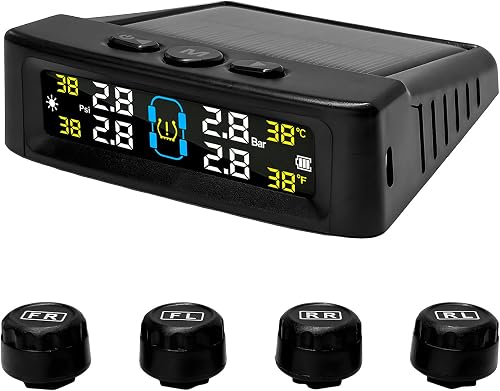 |  | 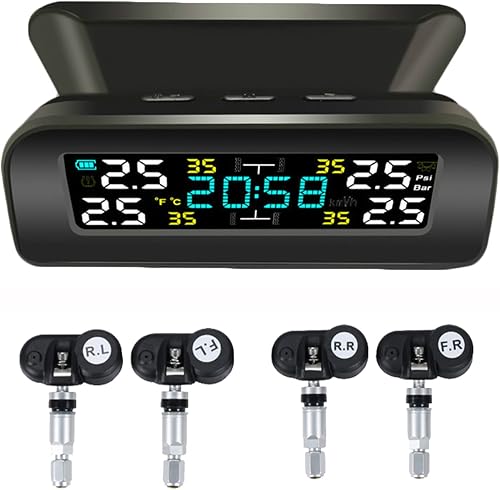 |
|---|---|---|---|---|---|---|---|---|---|---|
| Product | 2026 Solar TPMS | Tymate TM8 TPMS | Tymate TM12 TPMS | Solar Charging TPMS | Wireless Motorcycle TPMS | High PSI RV TPMS | Tymate TM2 TPMS | Tire Pressure Monitoring System | Trailer Tire Pressure Monitoring | Wireless Solar TPMS Internal |
| Brand | XBNVGP | Tymate | Tymate | Avutrel | LNKERCO | Flydew | Tymate | YTFRL | Avutrel | EOHMAK |
| Best for | Best Overall | Best for Commuters | Best for Large Vehicles | Best for Auto-Brightness | Best for Motorcycles | Best for High Pressure | Best for Compact Displays | Best for General Safety | Best for Long Trailers | Best for Internal Use |
| The listing says | 24/7 monitoring with 2 PSI precision 6 alarm modes with adjustable thresholds | Real-time monitoring with 1.5 PSI precision Solar and USB charging options | Supports up to 12 tires 6 alarm modes with IP67 waterproof sensors | 5 real-time security alarm modes Real-time pressure and temperature display | Real-time front and rear tire monitoring 7 smart alarm modes for safety | Adjustable 0-144 PSI alarm range Real-time monitoring for 6 tire positions | 6 alarm modes with simple threshold setup 4 external sensors with long battery life | Synchronous 4-tire pressure and temperature monitoring Waterproof ABS and wear-resistant PC display | Supports 4/6/8/10 wheel modes Pure copper sensors for corrosion resistance | Solar and USB charging options 6 alarm modes for safe driving |
| More information | Price on Amazon | Price on Amazon | Price on Amazon | Price on Amazon | Price on Amazon | Price on Amazon | Price on Amazon | Price on Amazon | Price on Amazon | Price on Amazon |
1. 2026 Solar TPMS
Best for: Drivers with vehicles up to 50 feet long.
This system monitors pressure and temperature with high precision, updating every 6 seconds to alert you of leaks or overheating. Its dual-charging capability via solar and USB-C ensures you’re never without power, even on long hauls. The device automatically powers down three minutes after the engine stops and wakes upon ignition to preserve battery life.
The installation takes about two minutes and requires no tire removal. You must install sensors in the specific positions—Left Front, Right Front, Left Rear, and Right Rear—to ensure accurate readings. The included hex nuts provide an anti-vibration seal, which helps keep the sensors secure during high-speed driving or off-road use. Always perform a soap water test after installation to verify a leak-free seal.
If your vehicle exceeds 50 feet, the signal range may be insufficient for reliable monitoring. Use the LCD menu to customize alert thresholds between 0 and 88 PSI to match your specific load or towing requirements.
- Pros:
- Fast 0.3-second sensor refresh rate.
- Tool-free two-minute installation process.
- Dual charging for reliable power.
- Cons:
- Not for vehicles over 50ft.
- Requires manual sensor positioning.
2. Tymate TM8 RV Tire Pressure Monitoring System
Best for: Daily commuters and long-distance travelers.
The Tymate TM8 provides consistent tire health data with precision up to ±1.5 PSI or ±3°F. It features a vibrant color LCD that mounts to the windshield, keeping your dashboard clear while ensuring the data remains within your line of sight.
The system is designed for vehicles under 20 feet, making it a great fit for smaller SUVs, sedans, and pickup trucks. It uses automatic calibration to set reference values, which simplifies the initial setup. Because this system isn’t compatible with the Tymate Repeater, you must confirm your total vehicle length is less than 20 feet before purchasing. If you exceed this length, the signal won’t remain stable.
For maximum sensor stability, you should install these units on metal valve stems. The system offers six distinct alarm modes, including alerts for rapid air loss and high temperatures. You can power the unit via the solar panel, or use a USB port if sunlight is unavailable.
- Pros:
- Windshield mount saves dashboard space.
- Precise real-time pressure monitoring.
- Simple automatic sensor calibration.
- Cons:
- Not compatible with signal repeaters.
- Limited to 20ft vehicle length.
- Requires metal valve stems for best results.
3. Tymate TM12 RV Tire Pressure Monitoring System
Best for: Large RVs and mid-sized trailers.
This system is built for complexity, supporting up to 12 tires across four zones. The split-screen cycling allows you to monitor your towing vehicle and trailer simultaneously without losing track of individual tire data.
The TM12 is designed for long-distance stability with a 50-foot signal range. If you’re towing large RVs or expect signal blockage, you must add a repeater to extend that range to 100+ feet.
For the most reliable connection, always install these sensors on metal valve stems. This prevents the instability that can occur with rubber stems during long hauls.
The system uses intelligent auto-calibration. If your pressure rises 25% above your reference value or drops 15% below it, the alarm will trigger. If you find the monitor won’t turn off, remember that the device only powers down manually when it isn’t actively charging via cable.
- Pros:
- Supports up to 12 tires.
- 50ft stable signal transmission range.
- Real-time multi-zone monitoring.
- Cons:
- More complex initial setup.
- Repeater needed for massive rigs.
4. Solar Charging TPMS
Best for: Drivers wanting a basic, easy-to-use monitor.
The Avutrel system uses 4 external sensors to track tire conditions in real time. The screen automatically adjusts its brightness, so you can see your data clearly whether you’re driving at night or in bright sunlight. You can rely on 5 alarm modes to alert you to rapid or slow leaks, pressure fluctuations, or high temperatures.
Installation is straightforward and takes about 3 minutes, following a simple manual or video guide. Because it’s optimized for 4-wheeled vehicles, it isn’t a suitable choice for those towing trailers or driving large RVs.
The system includes dual power options. Use built-in solar charging for daily maintenance, or switch to USB charging if you face extended periods of low light. This hybrid approach reduces device wear and ensures consistent operation.
- Pros:
- Auto-adjusting screen brightness.
- Simple three-minute installation.
- Low power consumption sensors.
- Cons:
- Designed exclusively for standard passenger vehicles.
- Limited monitoring capacity.
5. Wireless Motorcycle TPMS
Best for: Motorcycle riders needing compact monitoring.
This system is specifically designed for bikes, featuring a magnetic charging cable that prevents port wear. It wakes up when it senses vibration from your ride and enters sleep mode after parking, so you never have to remember to turn it off.
The LCD shows both front and rear tire data, and the flashing icons alert you to problems immediately. If you see a high-pressure, low-pressure, or high-temperature warning, you know exactly which tire is failing without stopping to check by hand.
Use this unit only for two-wheeled vehicles. It lacks the sensor capacity for cars or trucks, so don’t attempt to adapt it for larger frames. If your display shows a signal loss icon, check if the sensor battery is low before assuming a mechanical failure.
- Pros:
- Vibration-activated auto on/off.
- Convenient magnetic charging cable.
- Compact display for handlebars.
-
Real-time PSI or Bar and temperature readings.
-
Cons:
- Only for two-wheeled vehicles.
- Small display size.
6. High PSI RV TPMS
Best for: Vehicles requiring high-pressure monitoring.
With a range of 0-144 PSI, this system is well-suited for heavy-duty pickups and larger RVs. The six pre-paired sensors make it easy to set up, and the color LCD provides a clear overview of all tire positions.
Set custom high- and low-pressure alarm values based on your specific tire load conditions. If you’re towing a trailer, use the full set of six sensors to track both the vehicle and the towed load simultaneously. If you’re driving a standard SUV, you can keep the extra sensors as spares for future replacements.
The system includes audible and visual alarms that help you identify which tire is having an issue. It isn’t ideal for small passenger cars where such high-pressure tracking is unnecessary and potentially overkill. Avoid the mistake of ignoring the low sensor battery alert, as this will lead to signal loss during long trips.
- Pros:
- Wide 0-144 PSI monitoring range.
- Sensors come pre-paired.
- A variety of distinct alarm modes are available.
- Cons:
- Overkill for small cars.
- Requires manual sensor maintenance.
7. Tymate TM2 RV Tire Pressure Monitoring System
Best for: Drivers who prefer a compact display.
The TM2 provides a balance of accuracy and ease, with a color LCD that features automatic backlight adjustment. It can monitor up to 10 tires, making it flexible enough to move between your primary vehicle and a trailer. You can set your own alarm thresholds, with a range of +25% to -15% of your reference pressure.
The sensors are IP67 waterproof and built for harsh environments. Each sensor runs on a CR1632 battery that lasts up to six months, with a total sensor lifespan of two years. Because it requires a metal valve stem for the best stability, it may not be the right choice if your vehicle currently uses rubber stems that you’re unable or unwilling to replace.
If your trailer exceeds 36 feet in length, you must purchase a separate repeater to ensure the signal reaches the monitor. If you’re driving a shorter vehicle, the standard 433.92MHz signal provides reliable coverage.
- Pros:
- Compact, waterproof sensor design.
- Supports up to 10 tires.
- Automatic backlight adjustment.
- Cons:
- Metal valve stems recommended.
- Repeater needed for trailers over 36ft.
8. Tire Pressure Monitoring System
Best for: General vehicle safety monitoring.
The YTFRL system is built from durable ABS with a wear-resistant PC screen. It monitors four tires for both pressure and temperature, providing real-time data that helps you avoid issues on the road. A zero-delay voice alarm alerts you to a wide range of abnormal tire conditions.
Installation requires no tools and takes only minutes. First, clean the tire valve thoroughly before tightening the external sensor to ensure a secure fit. If you notice the display failing to update, check that the sensors are seated tightly on the valves.
The monitor features dual charging via solar power or USB. It automatically powers on when the vehicle starts and shuts down after parking to conserve energy. This unit is designed for vehicles with tire pressure values within 5 bar, such as sedans, vans, or RVs. It isn’t suitable for heavy-duty industrial equipment that exceeds this pressure range.
- Pros:
- Durable ABS and PC construction.
- Tool-free, quick installation.
- Real-time temperature monitoring.
- Cons:
- Designed for use with a standard set of tires.
- Standard range only.
9. Trailer Tire Pressure Monitoring
Best for: Large tow setups and trailers.
This system features a large 7-inch display and a signal amplifier to ensure consistent data transmission over long distances. It includes extra data like an inclinometer and speed, which can be helpful for those towing heavy loads.
The copper-core sensors are designed to resist corrosion, which is a benefit for drivers in wet or salty environments. This system is quite large and complex, so it may be too much for a standard commuter car.
- Pros:
- Large 7-inch display screen.
- Signal amplifier for stability.
- Corrosion-resistant copper sensors.
- Cons:
- Very large display footprint.
- Complex setup for beginners.
10. Wireless Solar TPMS Internal
Best for: Those who prefer an internal sensor setup.
This system uses internal sensors to keep your valve stems looking clean. It offers dual charging and multiple alarm modes to ensure you’re alerted to any rapid or slow leaks immediately. The monitor displays real-time pressure and temperature, and you can toggle units between PSI/Bar and Celsius/Fahrenheit to match your preference.
Because the sensors are internal, the installation process is significantly more involved than external systems. You must have the tires professionally mounted and balanced to accommodate the sensors, making this a poor choice for someone who wants a quick, DIY-friendly upgrade. If you value a streamlined aesthetic over ease of maintenance, this internal setup is the right path.
If the monitor triggers an alarm for high pressure, high temperature, or sensor battery failure, simply press any button to silence the alert. The default pressure range is set between 0.5 and 3.5 Bar. If your vehicle operates outside these standard parameters, this specific system may not provide the necessary monitoring range for your needs.
- Pros:
- Clean look with internal sensors.
- Dual solar and USB charging.
- Advanced alarm modes are included.
- Cons:
- Requires professional tire installation.
- Not a quick DIY job.
How to Choose in Sixty Seconds
Which difference between these systems actually matters most?
The most important factor is the signal range and the number of sensors. If you’re just driving a sedan, a standard sensor system like the Tymate TM8 is perfect. However, if you’re towing a trailer, you need a system that supports more sensors and has a stronger signal, such as the Tymate TM12. Signal blockage is common in long vehicles, so always check if the system supports a repeater or has a built-in amplifier.
What should I skip when comparing these models?
Skip models that don’t offer dual charging. A solar-only system might struggle on cloudy days or during winter months when sunlight is scarce. Having a USB-C or magnetic charging backup is vital to ensure your monitor never goes dark while you’re driving. You should also skip any system that lacks customizable alert thresholds if you frequently change your load, such as switching between an empty trailer and a fully loaded one. The ability to set your own PSI limits ensures the alarm only goes off when it’s truly necessary, preventing “alarm fatigue” that might cause you to ignore real warnings.
What should I confirm before ordering?
Always confirm the valve stem type on your vehicle. Many external sensor systems suggest using metal valve stems to support the extra weight of the sensor and ensure a secure, leak-free fit. Additionally, check the pressure range of the system against your tires. If you have a heavy-duty truck or a high-pressure trailer setup, ensure the system can handle the PSI requirements, as some units cap out at 87 PSI while others can monitor up to 144 PSI.
Frequently Asked Questions
What does the system need to work with my tires?
Your vehicle must have metal tire valve stems to support the weight of external sensors. Metal stems prevent the valve from flexing and leaking while driving. You should replace old rubber stems with metal ones before installation to ensure a secure, airtight fit.
What goes wrong with these systems first?
Signal loss is usually caused by excessive distance or metal interference between the sensors and the monitor. Systems designed for larger vehicles often include a repeater to maintain a stable connection. If a sensor stops reporting, check the battery first, as it is the most common point of failure.
Is the simplest system on this list enough for my needs?
A basic TPMS is sufficient for most passenger cars and small SUVs. These models provide essential real-time pressure and temperature monitoring without the complexity of extra zones. If you are not towing a trailer, you do not need the additional sensors or signal amplifiers found in advanced units.
Closing
For most drivers, the 2026 Solar TPMS stands out as the best overall choice. Its high-precision sensors refresh every 0.3 seconds, providing the real-time data necessary for highway safety. The dual-charging setup—solar for daily use and USB-C for low-light conditions—ensures your monitor remains powered without occupying a cigarette lighter socket.
If you’re managing a large RV or a multi-axle trailer, the Tymate TM12 is the superior pick. It supports up to 12 tires and includes a signal amplifier to maintain a stable connection over 50 feet. Without this repeater, users on long rigs often face signal attenuation or garbled data.
Before you finalize your order, check your tire pressure range. Systems like the TM12 or Flydew support up to 144 PSI, whereas others cap at 88 PSI. Choosing a system that can’t handle your maximum tire pressure will prevent proper calibration. Always confirm you have metal valve stems; installing external sensors on rubber stems can lead to instability. Verify your total vehicle length and sensor count, then proceed to the product page to secure your new monitoring system.
