
Choosing the best digital car battery load tester means finding a tool that balances clear data with ease of use. These devices differ mainly in their display technology, range of battery compatibility, and extra features like printing or specialized lithium support. Reliability and build quality are the key factors for long-term use.
Best overall: TOPDON BT200, which offers high-precision diagnostic tools and a color screen that stays readable in direct sunlight, making it a reliable choice for both DIYers and professional mechanics. Best for first-time users: FOXWELL BT705, which provides simple, step-by-step prompts on its screen to help you understand battery health without needing to interpret raw numbers or complex technical data. Best for professional records: TOPDON BT600, which includes a built-in thermal printer that allows for immediate, paper-based proof of battery health reports, ideal for service shops and record-keeping.
This guide is for anyone looking to maintain their vehicle’s battery health and avoid unexpected starting issues.
How We Picked
We compared 48 Amazon listings to identify the most capable battery testers available today. To earn a spot, each product had to provide clear, manufacturer-stated specifications regarding battery compatibility, CCA ranges, and diagnostic capabilities. Products were excluded if they lacked clear data on their operating temperature ranges or safety protections. We focused on tools that provide consistent, actionable information rather than just basic voltage readings.
All 10 products side by side — scroll sideways to see every column.
| Top Pick | Best for Long Reach | Best for Printed Records | Best for 6V Batteries | Best for Lithium Batteries | Best for Data Storage | Best for AGM Batteries | Best for Glove Boxes | Best for Simple Testing | ||
| Preview |  |  |  |  |  |  | 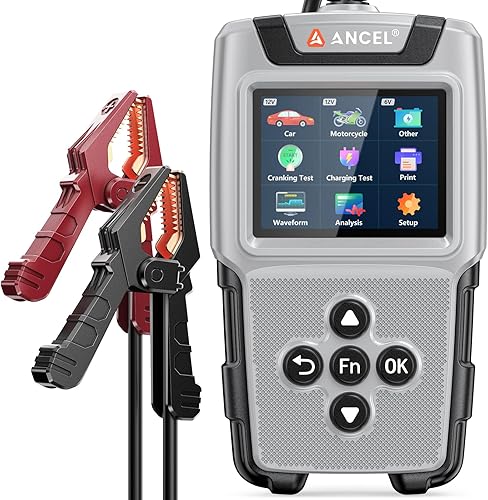 |  |  |  |
|---|---|---|---|---|---|---|---|---|---|---|
| Product | TOPDON BT200 | FOXWELL BT705 | TOPDON BT600 | OTC 3182 Digital Tester | ANCEL BT410 | VDIAGTOOL BT500 | ANCEL BA101 Plus | Clore Automotive SOLAR | KONNWEI KW208 | MOTOPOWER MP0514A |
| Brand | TOPDON | FOXWELL | TOPDON | OTC | ANCEL | VDIAGTOOL | ANCEL | Clore Automotive | KONNWEI | MOTOPOWER |
| Best for | Best Overall | Best for Long Reach | Best for Printed Records | Best for 6V Batteries | Best for Lithium Batteries | — | Best for Data Storage | Best for AGM Batteries | Best for Glove Boxes | Best for Simple Testing |
| The listing says | Tests 12V and 24V batteries 100-2000 CCA Performs battery, cranking, and charging tests | Checks CCA, voltage, internal resistance, and SOH Includes 2.8-inch screen with guided prompts | Performs battery, cranking, and charging tests Supports 12V and 24V batteries 100-2000 CCA | Tests 130 ampere load Tests 6 and 12 volt batteries | Tests 12V and 24V lead-acid and lithium batteries Displays SOC, SOH, voltage, and internal resistance | Tests 6V, 12V, and 24V battery types Analyzes cranking and charging systems | Tests 6V and 12V batteries 20-2000 CCA Checks battery health, cranking, and charging status | Tests 12V batteries and systems Capacity of 40-1200 CCA | Tests 12V batteries 100-2000 CCA Features galvanized alloy battery clips | Features plug-and-test design Includes reverse and over-voltage protection |
| More information | Buy on Amazon | Buy on Amazon | Buy on Amazon | Buy on Amazon | Buy on Amazon | Buy on Amazon | Buy on Amazon | Buy on Amazon | Buy on Amazon | Buy on Amazon |
1. TOPDON BT200 Car Battery Tester
Best for: DIYers and mechanics needing professional accuracy.
The TOPDON BT200 uses advanced conductance technology to analyze 12V and 24V batteries with high precision. Its rugged housing and copper clamps are built to withstand daily use in home garages or busy shops. The color LCD screen remains clear even in bright sunlight, which simplifies reading results while working outdoors.
Use the cranking test to analyze your starting motor if your engine struggles to turn over. If you suspect an electrical issue, run the charging test to confirm the system isn’t overcharging or undercharging your battery. This prevents the common mistake of replacing a healthy battery when the actual culprit is a faulty alternator or charging system.
This tester isn’t for users who specifically need to print physical diagnostic reports, as it lacks the built-in printer found in other models. It’s designed to be a reliable, handheld diagnostic tool for those who want a clear “Good” or “Replace” prompt on their screen. If you operate in freezing conditions, this unit remains effective down to -4°F, unlike basic testers that often fail in the cold.
Pros
- High 99.9% testing accuracy.
- Works in extreme temperatures.
- Clear sunlight-readable color display.
Cons
- No built-in report printer.
2. FOXWELL BT705 Car Battery Tester 24V 12V
Best for: Someone working alone who needs long cables.
The FOXWELL BT705 features a 5.9 ft test cable that reaches from the battery to the driver’s seat. This allows a single person to perform cranking tests while sitting inside the vehicle. You can monitor cranking voltage and time during startup without needing a second person to help.
The device provides guided, step-by-step prompts on its 2.8-inch screen. It summarizes results as GOOD, RECHARGE, or REPLACE. This helps first-time users understand battery health, cranking performance, and charging output without interpreting raw data.
This unit isn’t designed for users who require the smallest possible tool. It’s a substantial device built for repeated, professional use in home garages or fleet maintenance. Use it to check 12V and 24V systems, including Flooded, AGM, GEL, and EFB batteries ranging from 100–2000 CCA.
If you need to verify a newly purchased battery before installation, use this tool to catch weak cells early. Avoid the mistake of replacing a good battery by checking CCA, voltage, internal resistance, and SOH first. It remains effective even during cold 32°F (0°C) testing.
Pros
- Long cables for solo testing.
- Includes a hard carrying case.
- Simple, step-by-step user interface.
Cons
- Larger size than basic testers.
3. TOPDON BT600 12V 24V Car Battery Tester
Best for: Auto shops needing printed records.
The TOPDON BT600 includes a built-in thermal printer for printing reports. This allows technicians to provide customers with immediate, physical records of battery, cranking, and charging system tests. It supports a wide range of 12V and 24V lead-acid batteries, including flooded, AGM, GEL, and EFB types.
If you’re a professional, use the built-in printer to provide proof of service for every job. If you’re a shop owner, rely on the data playback function to save the last test performed for your records. Don’t mistake this for a basic voltmeter. With a CCA range of 100 to 2000A, it’s built for heavy-duty trucks and boats as much as sedans.
If you need to update the software, ensure you have a Windows-based PC, as the mini-USB port isn’t compatible with other operating systems.
Pros
- Built-in thermal paper printer.
- Large 3.5-inch color screen.
- Software updates via USB.
Cons
- Requires Windows PC for updates.
4. OTC 3182 130 Amp Digital Battery Load Tester
Best for: Those needing robust load testing.
The OTC 3182 focuses on a 130-ampere load test to provide accurate results for 6V and 12V systems. Its design is compact and lightweight, making it easy to carry around a garage or keep in a vehicle. The ergonomic handle is shaped for a comfortable grip during testing.
If you’re performing routine maintenance, rely on this tool for its direct, traditional testing experience. Avoid this model if your workflow requires advanced digital menus or screen-based prompts, as those features are absent here. The unit is built for speed and simplicity rather than complex data analysis.
When using the tester, ensure you’re working with batteries within the 6V or 12V range. If you also manage heavy-duty tires, note that this tool’s design includes a 22-inch wide dolly capable of handling tire diameters ranging from 24 to 36 inches.
Pros
- Rugged, compact design.
- Accurate 130-amp load testing.
- Ergonomic handle for grip.
Cons
- No complex digital menus.
5. ANCEL BT410 12V 24V Car Battery Tester
Best for: Users with lithium and lead-acid batteries.
The ANCEL BT410 is highly versatile because it supports both lead-acid and lithium-ion batteries. This makes it a great choice for households with a mix of vehicles, including motorcycles, RVs, and cars. It also provides a shareable QR report, which is helpful for keeping digital records of battery health.
If you’re struggling to start your engine, don’t just check the battery voltage. Use the BT410 to analyze cranking and charging performance under load. This helps you distinguish between a weak starter, a failing alternator, or excessive ripple voltage. Knowing the difference prevents you from wasting money on unnecessary repairs.
This device isn’t for those who only own standard lead-acid batteries and don’t need the extra compatibility with lithium systems. It’s best for the modern user who needs one tool that covers almost every type of battery found in a garage. The ANCEL BT410 features reverse polarity protection to guard against accidental reversed connections.
Pros
- Supports lithium-ion batteries.
- Includes shareable QR reports.
- Long 31.5-inch testing cables.
Cons
- Not for 24V lithium systems.
6. Car Battery Tester 6V 12V 24V VDIAGTOOL BT500
Best for: Users needing a wide CCA range.
The VDIAGTOOL BT500 supports a broad range of 5–3000 CCA, making it useful for everything from small motorcycle batteries to heavy-duty truck batteries. It features an anti-slip grip and a shock-resistant body, which is helpful when working in tight, messy engine bays.
If you’re testing a 6V motorcycle battery, you must select the dedicated mode via the “Motorcycle” menu to ensure precision. For 12V or 24V systems, always confirm the specific battery type and CCA value before starting the test. Failing to input these settings correctly will lead to inaccurate diagnostics.
This tester isn’t for users with lithium, deep-cycle, or golf cart batteries. Attempting to use the BT500 on these unsupported types won’t yield reliable data. It’s built for those who primarily deal with standard lead-acid, AGM, GEL, and EFB systems.
Pros
- Wide 5–3000 CCA range.
- Shock-resistant, anti-slip housing.
- Dedicated 6V motorcycle mode.
- Charging and cranking system analysis.
Cons
- Not for lithium, deep-cycle, or golf cart batteries.
7. ANCEL BA101 Plus Car Battery Tester
Best for: Tracking battery history.
The ANCEL BA101 Plus allows you to store up to 1,400 test records, which is excellent for tracking the degradation of a battery over several months. You can replay up to 120 seconds of data to spot voltage drops during cranking or charging checks. The “Fn” shortcut key lets you start a test instantly, saving time if you’re checking multiple batteries in a row.
This tester isn’t for users who need to test 24V systems or lithium batteries, as it’s strictly limited to 6V and 12V lead-acid batteries. To get accurate results, always enter the correct battery type, standard, and rated CCA value from the label. If your antivirus software flags the printing installation program, simply select “Allow” or “Trust” to proceed; the software is secure but may trigger alerts because it’s a dedicated, non-mainstream program. It’s best for those who want to build a historical log of their battery health to catch issues before they cause a breakdown.
Pros
- Stores 1,400 test records.
- Fast one-touch “Fn” test.
- Detailed voltage curve review.
Cons
- No 24V or lithium support.
8. Clore Automotive SOLAR Digital 12V Battery and System Tester
The Clore Automotive SOLAR is a dedicated 12V tester designed for simplicity and performance. It covers a 40–1200 CCA range and is compatible with common battery types like Flooded, AGM, and Gel. The LCD screen is designed to be visible in various lighting conditions.
If you’re working on a standard passenger vehicle, this unit provides the precise metrics required to verify battery health. However, you must confirm your system voltage before connecting the clamps. Because this tool operates strictly within a 7–15V range, it won’t function on 6V vintage systems or 24V heavy-duty setups. Attempting to force a connection on these incompatible voltages risks inaccurate readings or potential damage to the internal circuitry.
The device is best suited for the professional or serious home mechanic who prefers a specialized, no-nonsense interface. By focusing exclusively on 12V architecture, the SOLAR eliminates the menu clutter found on multi-voltage diagnostic tools. If your garage primarily services modern cars and light trucks, this focused design allows for faster, more reliable testing cycles. You gain a streamlined workflow by sacrificing the versatility found in more complex, universal diagnostic equipment.
9. KONNWEI KW208 12V Car Battery Tester
Best for: Keeping in a glove box.
The KONNWEI KW208 is designed to be compact and easy to store, making it a convenient tool to keep in your car at all times. It tests 12V batteries from 100–2000 CCA, including regular flooded, AGM flat plate, AGM spiral, and gel types. The device provides professional advice on whether to replace or recharge the battery based on internal resistance, AH capacity, and health status.
This tester isn’t for users who need to test batteries outside the 12V range, such as 6V or 24V systems. If you’re testing a dead battery, the unit functions in-vehicle or out-of-vehicle. Simply connect the clips to the terminals; the device powers on automatically for immediate analysis. Use the galvanized alloy clips to ensure a secure connection, as these updated components provide the 99.7% accuracy required for reliable results.
Pros
- Very compact, glove-box friendly.
- Simple plug-and-play operation.
- Galvanized alloy battery clips for better contact.
- Tests cranking and charging systems.
Cons
- 12V systems only.
- Can’t test 6V or 24V batteries.
10. MOTOPOWER MP0514A 12V Digital Car Battery Tester Voltmeter and Charging
Best for: Simplest possible operation.
The MOTOPOWER MP0514A uses colored LED indicators alongside a 4-digit digital display to show battery status, making it very easy to interpret. Its “plug-and-test” design means there are no complex menus to navigate, which is perfect for someone who just wants a quick status update.
If you’re unsure whether your battery needs a jump-start or a full replacement, check the voltage before and after starting the engine. If the reading is outside the 4 to 20V DC range, the device won’t provide a standard result. Always ensure the 30A alligator clips are attached correctly; the unit includes reverse connection and over-voltage protection to prevent damage if you accidentally swap the poles.
This tester isn’t for users who need detailed technical data like internal resistance or specific CCA analysis, as it focuses on simple, intuitive status indicators. It’s best for the car owner who wants to know if their battery is good or needs a jump without any technical fuss.
Pros
- Extremely simple LED indicators.
- Compact and lightweight at 150 grams.
- Accurate 0.01-volt readings.
Cons
- Lacks advanced technical data.
How to Choose in Sixty Seconds
Does the battery type matter?
Yes, you must match the tester to your battery chemistry. While many devices handle standard flooded lead-acid and AGM batteries, lithium-ion batteries require specific support. The ANCEL BT410 is one of the few models that explicitly supports both lead-acid and lithium-ion batteries. Conversely, the VDIAGTOOL BT500 is strictly for lead-acid and won’t work on lithium, deep-cycle, or golf cart batteries. Always check the product description to ensure it supports your specific battery type. Using a tester on an incompatible battery can lead to inaccurate results or potential safety risks.
Before buying, confirm the CCA (Cold Cranking Amps) rating of your vehicle’s battery. Ensure the tester’s range covers your battery’s CCA capacity. While most testers cover 100-2000 CCA, the VDIAGTOOL BT500 extends this range to 3000 CCA, making it better suited for heavy-duty applications. For high-performance vehicles or heavy-duty trucks, verify that the device can handle the higher CCA requirements of those larger, more powerful batteries.
Should I look for extra features?
Data storage is helpful if you want to track battery health to predict failure; the ANCEL BA101 Plus, for instance, allows you to store up to 1,400 records.
If you prefer simplicity, avoid devices with complex menus that require software updates or PC connectivity. Focus on the core diagnostic capability first, then add features only if you’ll use them. If you work alone, prioritize cable length. The FOXWELL BT705 features a 5.9 ft cable, while the ANCEL BT410 provides 31.5-inch cables, both allowing you to reach from the battery to the driver’s seat to perform tests without a second person.
What safety features are essential?
Safety is paramount when working with car batteries. Look for devices that explicitly state they have reverse polarity and short-circuit protection. These features prevent damage if you accidentally touch the clips together or connect them to the wrong terminals. The VDIAGTOOL BT500 and ANCEL BT410 include multi-layer protection against reverse polarity and short circuits, which is critical for protecting sensitive vehicle electronics.
Never use a tester that doesn’t mention these basic safety protections, as the risk of damaging your vehicle’s sensitive electronics is a significant concern.
The TOPDON BT200 remains our top pick for its combination of precision and reliability, while the FOXWELL BT705 is an excellent alternative for those who need to test their vehicles alone. If you find yourself frequently needing to document your results for professional purposes, the TOPDON BT600 is worth considering for its built-in printer. Taking the time to pick the right tool now will save you from the frustration of a dead battery on a cold morning. Maintenance is the best way to ensure your vehicle is always ready to start when you need it most.
Related guides
- 10 Best Digital Automotive Circuit Tester Pens for Diagnostics
- 10 Best Digital Tire Pressure Monitoring Solar Systems Reviewed
- Load Index and Speed Rating for Performance Tires
Frequently Asked Questions
What does a battery load tester actually do?
A battery load tester determines battery health by simulating the electrical demand of starting a vehicle. Unlike a standard voltmeter that only measures surface voltage, a load tester applies a controlled current to verify if the battery can hold its voltage under stress. Note that most modern digital testers use conductance technology to estimate health.
Do I need to charge the battery before testing it?
You should ensure your battery has a sufficient state of charge before performing a load test. While many modern testers can analyze a low battery, a severely discharged unit may provide a false “Replace” reading. If the battery remains weak after a full charge, you can be confident the internal health has degraded.
What usually goes wrong with these testers first?
The connection clips are the most common point of failure for battery testers. Because these clips are frequently attached and removed, the cables can fray or the internal springs can weaken. To extend the life of your tester, avoid pulling on the cables and store the unit in a dry, safe place.
Is the simplest tester enough for my needs?
A simple tester like the MOTOPOWER MP0514A is sufficient for most average car owners. If you only need to verify battery or alternator status, you do not require advanced features like printing or data logging. These compact testers provide clear feedback and are easy to store in a glove box.
Conclusion
Investing in a high-quality tester saves you from unexpected breakdowns and costly roadside calls. Once you’ve picked the right model for your garage, keep it stored in a dry, cool place to ensure it stays accurate for years. You’ll feel much more confident the next time your engine won’t start.
